
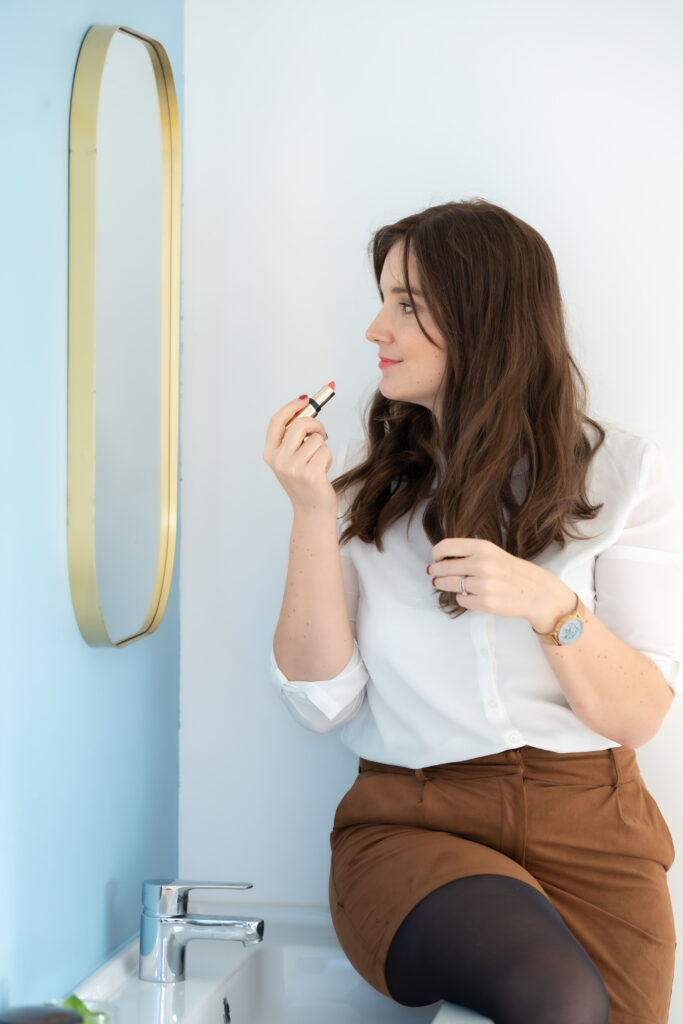
What if I told you about my journey, my experience with androgenetic alopecia?
The more women with androgenetic alopecia I meet through Comme un diadème, the more I realize how similar our experiences can be. Even though each woman's experience is different, especially on a psychological level, as everyone reacts differently to this challenge.
Dream hair for a great start in life 😀

Until I was a teenager, I had very thick hair. Hairdressers often complimented me on it. Unfortunately, I didn't appreciate it at the time! 😀 I remember having so much hair that I couldn't wrap the elastic band around more than once to tie it back. I have a memory from middle school of inwardly cursing those hair clips that were always too small to hold all my hair effectively.
In short, all this to say that I started out with a good hair foundation hair life, and yet...
The end of adolescence, the beginning of adulthood... and androgenic alopecia
Around the age of 17, my hair began to thin. I didn't notice it right away at the time. But it's something I can see now, looking back at old photos. I think my alopecia must have started around the end of puberty.

When I was around 20, my mother started to worry. She told me she had noticed that I was losing my hair, that my scalp was becoming sparse, and that my part was widening a little. At the time, I didn't take her seriously. I was in the middle of midterms at college and wasn't interested in any of that. I felt I had more important things to deal with at the time than temporary hair loss.
However, she insists repeatedly. I catch her looking at my scalp with a half-frightened, half-sympathetic look. I decide to see a dermatologist. Mainly to make her happy and reassure her, because I wasn't worried at all.
At 20 years old, the diagnosis is made.
So I went to see this dermatologist. He examined my scalp and made a few comments: "It's diffuse," "It's everywhere." At the time, I didn't understand that the term "diffuse" wasn't really positive when it came to hair loss. He suggested I have a blood test, then take iron and vitamins and come back to see him three months later. During that appointment, he also asked me if any members of my family were losing their hair. I told him that my father had been bald since the age of 20.
This simple question, and my answer, made me realize that I was definitely experiencing hair loss that might not be temporary. I went home and consulted Google. That's when I first came across the term androgenetic alopecia. I understood that this condition also affects women, whose scalp gradually thins as they age. Above all, I realized that this was certainly what I had. It was an intuition that told me that if there was such a problem to be had, it would be mine.
I conscientiously take vitamins (Cystine B6) and iron, despite the significant intestinal problems this causes me on a daily basis. Three months later, I return to see the dermatologist. He looks at my scalp and tells me that there has been no improvement. He then prescribes me 2% Minoxidil. I know, from everything I've read on the internet, what this prescription means.
He won't tell me outright that it's androgenic alopecia, but this prescription confirms it for me. Ironically for me, the dermatologist is bald. I tell myself that if this product really worked, maybe he wouldn't have just three or four hairs on top of his head... But I decide to try it anyway. If there's a battle to be fought, I feel ready to try.
I'm fighting for my hair
I buy the product and start the only local treatment available for women against androgenic alopecia. I want to believe in it. I want to tell myself that it will allow me to keep as much of my hair as possible and never go bald. I want to believe that I might even see regrowth and that my alopecia will no longer be detectable. In fact, my androgenic alopecia was hardly noticeable at the time anyway.
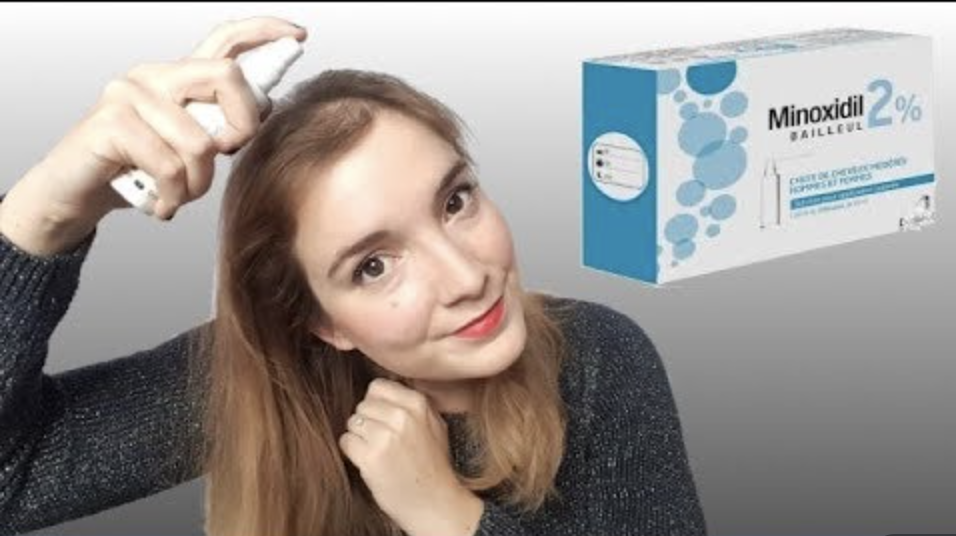
The problem with this treatment for me is that I find it makes my hair greasy. My hair doesn't feel properly clean after applying it (especially since you have to apply the product after shampooing, not before). I find that my hair loss is even more noticeable after applying it.
When I was around 20, my alopecia wasn't really noticeable. Initially, I didn't have a complex about it. But applying the product every day reminds me of the diagnosis on a daily basis. I find the treatment restrictive, but I continue because I'm too afraid that it will get worse if I stop.
Looking back now, 10 years later, I realize that this treatment made me focus on my alopecia when I could have just enjoyed my hair at the time, because I still had a lot of it.
The complex grows with age. Between the ages of 25 and 30, all I see in the mirror is alopecia. I no longer really look at myself, I look at my scalp. Under the spotlights in elevators, fitting rooms, in the reflections of subway windows, in store mirrors...
I can see some regrowth, but it's not enough to stop me from looking sparse. Not enough to give me the hair density of a normal girl. Not enough to stop me from focusing on it and feeling self-conscious.
After a while, I decide to go to the Sabouraud Center to confirm the diagnosis. I tell myself that, after all, the doctor was quite quick to make it. I didn't have a trichogram (it's not actually necessary to diagnose alopecia). I was diagnosed with androgenic alopecia, and the dermatologist prescribed Androcure and Minoxidil 5%, which is normally only prescribed to men because it is more concentrated and causes too many unwanted side effects in women.
I refuse to take Androcure because, after doing some research, I discovered that it has been banned by the Food and Drug Administration in the United States, which worries me. Furthermore, I do not want to take what I consider to be heavy hormone treatment to solve a cosmetic problem, even if it is difficult for me to deal with psychologically.
However, I agree to start treatment with Minoxidil 5%, but I don't tolerate it well. The formula burns and itches for several hours a day, but I continue. I have some side effects, such as migraines and hair growing... on the tops of my feet! 🥳 But I continue because I'm too afraid of what might happen if I stopped. I feel dependent on this product that I hate. I don't see any positive effects from the treatment, except on my feet and temples, but that wasn't really the desired effect.
I want a baby, and I'm quitting everything.
At the age of 29, my partner and I decided to have a baby. I decided to stop the treatment, which was a huge relief for me because I could no longer bear the daily constraints. After the birth of my daughter, I decided not to resume treatment because I had neither the desire nor the energy to do so. I breastfed my daughter for two years and therefore took a pill that was compatible with breastfeeding (Optimizette), but this had the side effect of worsening my alopecia.
My androgenic alopecia reached a critical stage about a year after the birth of my first daughter. That's when it became really noticeable, not only to me but also to others (although I received very few comments at the time, just looks).
It was also at this time, at the age of 30, that I decided to take the step of hair topper . And that I passed for the first time, the door of a wig store.
Find toppers and wigs in the Comme un diadème store:
For more information on toppers , wigs, and different solutions available to us in cases of androgenetic alopecia, feel free to check out my YouTube channel:




Thank you for this testimony, it was the stopping of my jasminelle pill that caused my alopecia. I was also prescribed androcure, which I took. Three months later I had a blood clot in my uterus because of it, not to mention a year later the letter from the CPAM which told me that taking this drug could cause brain tumours.
Anyway, in a few days, I'm going to receive my first hair topper, I'm a bit apprehensive. Will see, as my girlfriend would say.
Thank you for your comment and for sharing your experience. I don't think I mentioned it in the article, but I was also offered Androcure. I refused the treatment at the time because I saw that it was banned in the United States.
Hello
I have had androgenic alopecia for years
My mother has very little hair
The same goes for my father ´
So I have a hereditary condition that seems difficult to combat
I have tried everything over the last 25 years.
Intramuscular nicotine bepanthene
And I take dietary supplements all the time
I have tried local seum treatments
And now I am trying minoxidil 2% again
I am now 60 years old and finding it increasingly difficult to hide my alopecia (temporal and on the top of my head)
This causes me a lot of anxiety and self-consciousness on a daily basis.
It's becoming more and more noticeable.
I've even tried a special colored powder to cover up my scalp.
So I'm open to any advice!
My hairdresser has run out of ideas. 🥹
Thank you very much.
Hello,
Have you already considered the hair topper solution?