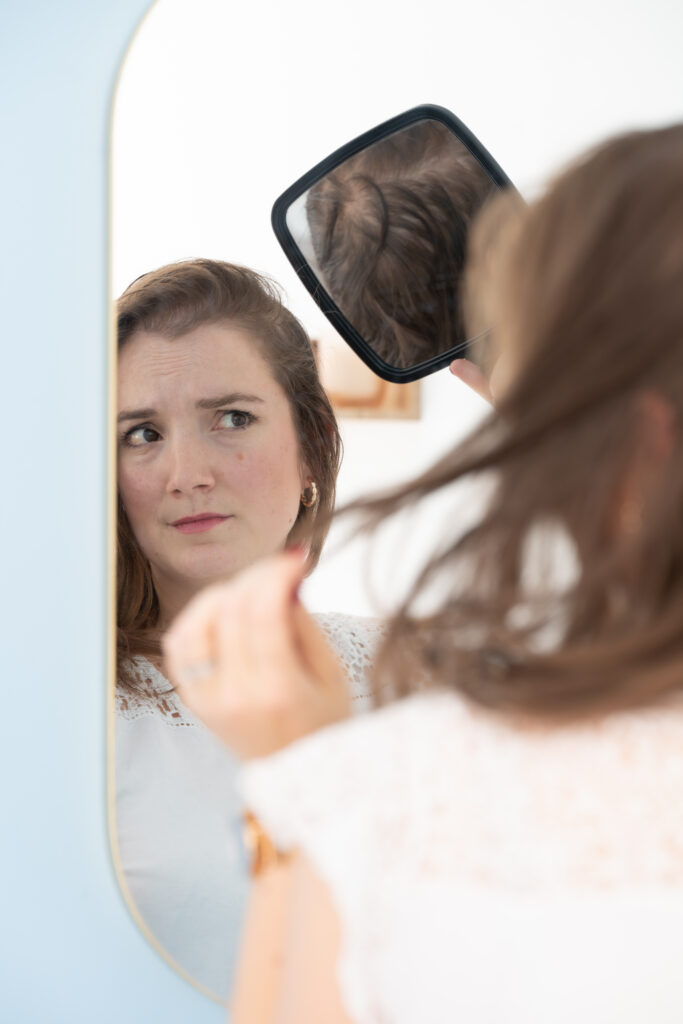
There is often a lack of understanding surrounding the physiological and genetic mechanisms behind androgenetic alopecia and the hair loss associated with this condition. This lack of understanding leads many people to seek solutions that have no chance of working against hair loss. This results in a waste of time, hope, energy, and money.
That's why the scientist in me is going to give you a simple, brief explanation that will help you better understand what is actually happening on our thinning heads 😉
1. How does androgenetic alopecia manifest itself?
In men, androgenetic alopecia is more commonly known as baldness. Generally, only the top of the head is affected by hair loss, and the hair on the crown is more preserved.
Androgenetic alopecia in women is characterized by more diffuse hair loss on the top of the head. Over the years, the hair becomes increasingly sparse. Generally, women do not become completely bald, unlike men.
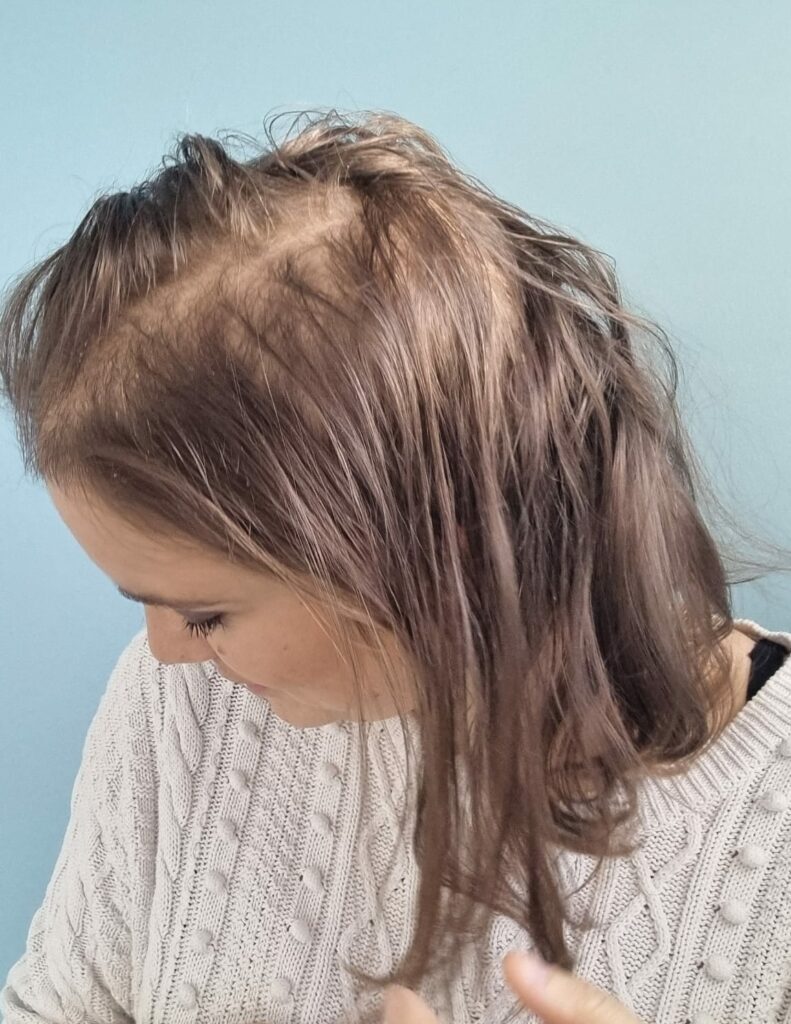
First important point: androgenetic alopecia in women is exactly the same as androgenetic alopecia in men: baldness.
I know how much this term can hurt. But I think it's important to face reality, and above all to understand it, in order to move forward.
2. Is it genetic?
Androgenetic alopecia is genetic, as there are genetic predispositions that cause alopecia. It is therefore not uncommon to see cases of androgenetic alopecia in our immediate family when we are affected.
As for me, my father went bald (except for the famous crown) at the age of 20. So I had good genetic groundwork for developing the same condition. I can officially hold him responsible for what's happening to me!!! It can be a relief to find someone to blame 😉
After some research, it seems that several hundred genes are involved in the development of baldness (at least 287!). And that a number of these genes are transmitted by the X chromosome, and therefore by the mother. But let's not panic, genetics is a very complex subject and it is therefore impossible to predict what will happen to our children if we have alopecia (my mother didn't lose her hair at all, for example).
3. But why do we actually lose our hair?
Genetic heritage has a direct impact on what happens at the physiological and molecular level. There are therefore also physiological causes that explain this hair loss.
In fact, in people with androgenetic alopecia, the hair follicle receptors, i.e., the molecular receptors located in our hair follicles, are slightly too sensitive to dihydrotestosterone (DHT), a hormone derived from testosterone (male hormone). When this hormone binds to the hair follicle receptors, they tend to go into overdrive, producing slightly too many cycles. The cycles then multiply and become shorter.
Androgens (=male hormones) are also present in women, albeit in smaller quantities. The fact that there are fewer of them means that the action of DHT will be less strong and that women affected by androgenetic alopecia will retain slightly more hair than men.
It is important to know that we are born with a predefined number of cycles in our lifetime. If these cycles occur in rapid succession, this explains why the scalp gradually thins out, as the hair gradually becomes finer and there is hair loss associated with advancing age. It is as if our hair is aging and dying prematurely!
During periods of hormonal upheaval, women may also experience increased hair loss. In cases of androgenetic alopecia, women may become increasingly thin-haired over the years, due to pregnancy and menopause.
4. Can we combat hair loss?
Unfortunately, as we have seen, androgenetic alopecia is a physiological and genetic process. So, just like aging, there is no way to fight it.
When you are affected by androgenic alopecia, the treatments that exist are lifelong and have limited effectiveness because they work against something that is genetic and physiological in us.
Androgenetic alopecia is therefore NOT linked to diet, chemical hair dyes, deficiencies, or poor lifestyle choices. Taking various supplements will therefore have no positive impact on hair loss. Various serums, castor oils, garlic, masks, incisions in the scalp, and over-the-counter treatments will also have no effect other than to make you waste money unnecessarily.
Minoxidil, certain hormone treatments, and LED therapy can be effective in treating hair loss. However, these are lifelong treatments, the benefits of which are lost as soon as you stop using them, and which, in my opinion (a very personal one), are too restrictive on a daily basis.
You can also check out my blog post on minoxidil and hair loss, as I took this medication for at least 5 years:
Understanding that you cannot fight androgenetic alopecia and hair loss is the first step toward acceptance. Because as long as you don't lay down your arms and spend your time struggling, you will suffer! The person writing these lines spent 10 years of their life stuffing themselves with iron supplements and making masks to prevent hair loss. Looking back today, I know that those were the years when I suffered most from my alopecia.
It's not easy to accept giving up the fight against hair loss. Besides, as I said earlier, there are medications that can help preserve your hair. It's a decision that everyone has to make for themselves. But being informed is important when making this decision. I see too many women trying treatments/serums/energy cuts/mesotherapy, sometimes spending thousands of euros without results.
Androgenetic alopecia and hair loss often cause enormous suffering for those affected. Many people understand this and are willing to try to sell us anything. Most of the time, we want so badly to believe it, so badly to fight it, that we are receptive to all this marketing talk. But is it really good for us in the end?
I also think that sometimes you have to have gone through all that despair to be ready to consider other solutions such as hair topper . I'm not sure today that I would have been ready to consider a prosthesis hair at the age of 25 (which was an age when I was already very concerned about my alopecia).
It is therefore up to each individual to forge their own path.
Take care and see you soon for a new article! 😘
To watch the corresponding explanatory video on hair loss and subscribe to my YouTube channel:
Join the Comme un diadème community on social media!
Are you experiencing hair loss? Androgenetic alopecia? Discover toppers and wigs from the brand Comme un diadème: