

There is often a misunderstanding about the physiological and genetic mechanisms behind androgenetic alopecia and the hair loss related to this condition. This misunderstanding leads many people to turn to solutions that have no chance of working against hair loss. This will be a waste of time, hope, energy, and money for them.
C’est pour cette raison que la scientifique qui est en moi va vous donner une petite explication simple et courte qui vous permettra de mieux comprendre ce qui se passe concrètement sur nos crânes clairsemés 😉
1. How does androgenetic alopecia manifest?
In men, androgenetic alopecia corresponds to what is more commonly known as baldness. Generally, only the top of the head is affected by hair loss, and the hair on the crown is more preserved.
Androgenetic alopecia in women is characterized by a more diffuse hair loss on the top of the head. Over the years, the hair becomes increasingly sparse. Generally, women do not become completely bald unlike men.
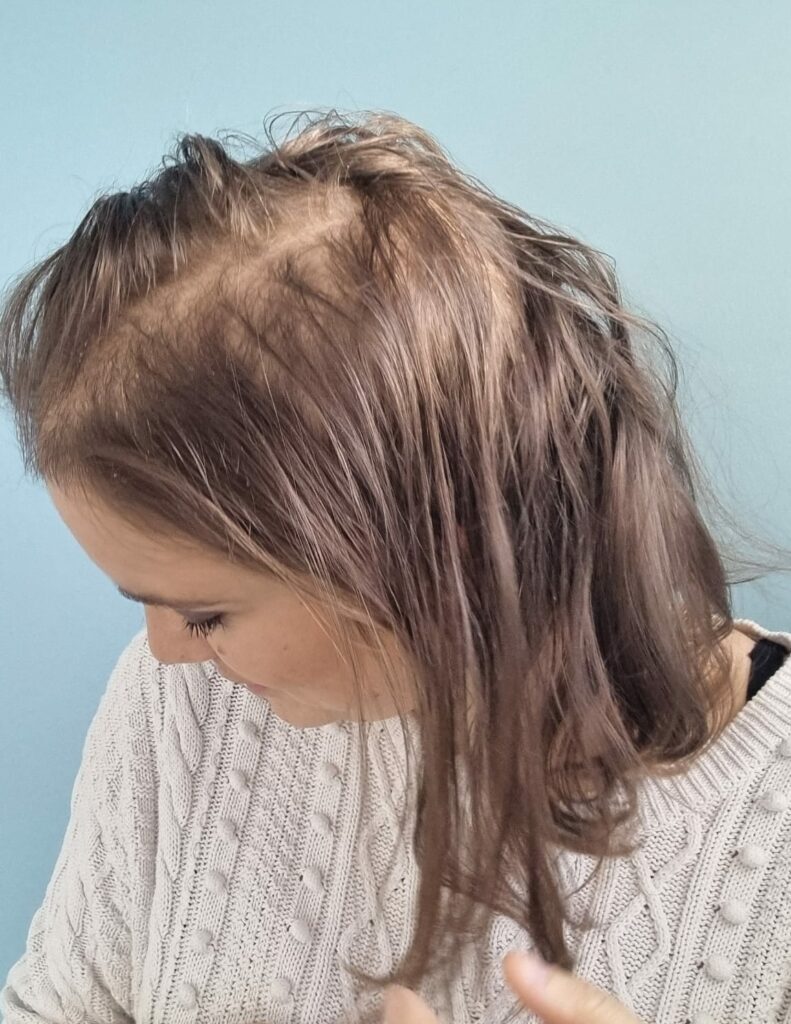
The first important point is that androgenetic alopecia in women is exactly the same as androgenetic alopecia in men: baldness.
I know how much this term can hurt. But I think it is important to face reality, and especially to understand it, in order to move forward better.
2. Is it genetic?
In androgenetic alopecia, there is genetics involved, as there are genetic predispositions that lead to alopecia. It is therefore not uncommon to observe cases of androgenetic alopecia in our close family when one is affected.
Pour ma part, mon père est devenu chauve (sauf la fameuse couronne) à l’âge de 20 ans. J’avais donc un bon terrain génétique à mon actif pour développer la même pathologie. Je peux officiellement le tenir responsable de ce qui m’arrive!!! Cela peut soulager de trouver un coupable 😉
After some research, it seems that several hundred genes are involved in the development of baldness (at least 287!). And that a certain number of these genes are transmitted by the X chromosome, thus by the mother. But let's not panic, genetics is something very complex and it is therefore impossible to predict what will happen to our children if we have alopecia (my mother did not lose her hair at all, for example).
3. But why do we actually lose our hair?
Genetic heritage has a direct impact on what happens on a physiological and molecular level. There are also physiological causes that explain this hair loss.
Indeed, in a person with androgenetic alopecia, the receptors of hair follicles, thus the molecular receptors located at the level of our hair follicles, are a bit too sensitive to dihydrotestosterone (DHT), which is a hormone derived from testosterone (male hormone). When this hormone binds to the receptors of hair follicles, they tend to get overactive, going through cycles too quickly. The cycles then multiply and shorten.
Androgens (=male hormones) are also present in women, albeit in smaller quantities. The fact that there are fewer means that the action of DHT will be less strong and that we retain a bit more hair than a man when we are a woman affected by androgenetic alopecia.
It should be noted that we have a predefined number of cycles over a lifetime. If these cycles occur at an accelerated pace, it explains why the scalp progressively thins as the hair gradually becomes finer and there is hair loss associated with aging. It's as if our hair ages and dies prematurely!
During periods of hormonal upheaval, women may also notice more significant hair loss. In cases of androgenetic alopecia, women may become progressively thinner over the years, pregnancies, and menopause.
4. Can we fight against hair loss?
Unfortunately, androgenetic alopecia is, as we have seen, a physiological and genetic process. Thus, like aging, we cannot fight against it.
When affected by androgenetic alopecia, the existing treatments are lifelong and have relative effectiveness because they go against something genetic and physiological within us.
Androgenetic alopecia has NO link with diet, chemical dyes, a deficiency, or a poor lifestyle. Supplementing with various capsules will therefore not have a positive impact on hair loss. Various serums, castor oils, garlic, masks, scalp incisions, and pharmacy cures will also have no effect other than to make you lose money unnecessarily.
Minoxidil, certain hormonal treatments, and LEDs can have effectiveness on hair loss. But these are lifelong treatments, from which we lose the benefits as soon as we stop them, and which are, in my opinion (very personal opinion), too burdensome on a daily basis.
You can also check out my blog post on minoxidil and hair loss, as I took this medication for at least 5 years:
Understanding that one cannot fight against androgenetic alopecia and hair loss is the first step towards acceptance. Because as long as we do not lay down our arms, spending our time struggling, we suffer! The person writing these lines spent 10 years of their life loading up on iron/capsules, doing masks to prevent hair loss. In hindsight today, I know that those were the years I suffered the most from my alopecia.
It is not easy to accept stopping the fight against hair loss. Moreover, as I mentioned earlier, there are medications that can help retain hair. It is a decision that everyone must make personally. But being informed is important in making this decision. I see too many women trying treatments/serums/energy cuts/mesotherapy, sometimes for thousands of euros with no results.
Androgenetic alopecia and hair loss often cause immense suffering for those facing it. And many people have understood this well and are ready to try to sell us anything. And most of the time, we are so eager to believe it, so eager to fight that we are receptive to all this marketing talk. But is it really positive for us in the end?
I also think that sometimes you have to go through all this despair to be ready to consider other solutions like the hair topper. I'm not sure today that I would have been ready to consider a hair prosthesis at the age of 25 (which was already an age when I was very self-conscious about my alopecia).
So it is up to each person to find their own path.
Prenez soin de vous et à très vite pour un nouvel article ! 😘
To watch the corresponding explanatory video on hair loss and subscribe to my YouTube channel:
Join the Comme un diadème community on social media!
Do you have hair loss? Androgenetic alopecia? Discover the hair toppers and wigs from the brand Comme un diadème:









Bonjour madame. Je vous écrit pour vous remercier. La première fois que j’ai vu une de vos vidéos sur l’alopécie il y a 2,3 ans, j’ai eu un choc ! Je perds mes cheveux depuis 23 ans ( je suis âgée de 33 ans) et ma dermatologue ne m’avait jamais dit que c’était incurable ni aussi bien expliqué ce » hancicap ». Pendant quelques mois je me suis sentie assez déprimée et désespérée. J’ai dû effectuer un vrai travail de deuil… Puis pendant un et demi je réfléchissais à la possibilité de porter une prothèse.. Je vous avais même contacter et envoyé une photo de moi. Le budget est un peu élevé pour moi. Alors je me suis rendue chez une perruquière de ma ville ( Metz) et là, j’ai pu acheter une prothèse capillaire très belles. Assez courte blonde effet racines à 500 euros environ. La boutique s’intitule » places à elles » et la dame à mis des photos de moi sur facebook. Je n’aime pas les cheveux longs car non pratique lol. Je suis très très satisfaite de mon achat, enfin heureuse et normale comme les jeunes femmes de mon âge. Si un jour, j’ai la chance de me marier avec mon conjoint, c’est promis, je m’acheterai une jolie perruque » comme un diadème » à 1500 euros ! Je voulais également vous informer que toutes vos vidéos où vous exprimer votre ressenti sur l’alopécie eh bien je partage exactement les mêmes pensées que vous. J’espère ne pas avoir été trop maladroite dans mes écrits. Cordialement. Cateline prella
Bonjour, j’ai bientôt 50 ans et je scrute ma perte de cheveux depuis ma 1ère grosse chute à l’âge de 16 ans..bien sûr si je vous écris c’est que la situation ne cesse d’empirer..j’ai tellement tout essayé et je suis fatiguée, j’avoue…blasée et pourtant je n’arrive pas à m’y résoudre…
Question:est ce que le complément capillaire n’accélère pas la perte des quelques cheveux qui restent?..je ne sais pas si je vais passer le cap mais wn tout cas merci pour vos vidéos qui m’ont apporté du soutien.
Stéphanie