


When one has androgenetic alopecia and is losing hair chronically, one sometimes lives with a significant physical complex on a daily basis. The gradual hair loss and seeing one's scalp thinning progressively over the years is very painful for a woman. Androgenetic alopecia strongly undermines femininity and self-esteem.
In our time, there are real solutions to address this aesthetic problem, including hair extensions such as hair toppers and wigs. However, crossing the threshold of hair extensions is far from always being psychologically easy, and many women will then wonder what the right time will be to wear a hair topper or a wig.
Should one wait until being very sparse, until their alopecia becomes visible to those around them? Or on the contrary, is it more reasonable to consider this type of solution at the first signs of alopecia?
In this article, you will find my testimony about this step of transitioning to hair extensions and my advice on determining the best time for you to consider such solutions.
The psychological consequences of androgenetic alopecia

When I was diagnosed with my androgenetic alopecia around the age of 20, the consequences of the disease were still very little visible. However, over the years, my scalp began to become very sparse. It became increasingly difficult for me to hide the problem with hairstyling strategies. The thickening powder also became insufficient to mask the hair loss. This then became a real complex for me. I only saw my alopecia in the mirror. I no longer felt pretty and simply could not be beautiful. And it was futile to try to be, because who could be beautiful while becoming bald?
Spending several years perceiving myself this way inevitably has consequences on self-esteem. I no longer really wanted to look at myself, to face the sad reality. I would look away from mirrors, or on the contrary, I would only focus my attention on my sparse scalp. I had become alopecia, nothing but alopecia.
From the testimonies that are regularly shared with me on the social networks of Comme un diadème, I see that many women experience similar situations due to their hair loss. Some women count their lost hairs every day. Others no longer dare to leave their homes or spend entire evenings crying or browsing forums dedicated to this problem. The psychological impact of androgenetic alopecia can be very significant and considerably affect quality of life.
I myself let alopecia ruin part of my life for several years. Then, I decided to move forward, to face the problem, and to try the solutions available to me.
Transitioning to hair extensions: my trigger!
I became aware of hair toppers around the age of 28, thanks to a YouTube video. However, I didn't feel truly ready to try this type of solution at that time. Imagining myself going to a wig store, being one of the women who wears a hairpiece, a toupee... All of that was a bit too difficult for me to consider back then!
But I also thought it was good to know that there was a real aesthetic solution to my problem! I then promised myself internally that I would have to consider the hairpiece when my alopecia became too painful to live with on a daily basis.
Four years later, after my first pregnancy, my alopecia had progressed significantly. The complex associated with it had also grown. I no longer accepted taking photos with my 3-year-old daughter when my hair was too 'dirty' to be presentable. The real trigger was noticing during a coffee break that one of my colleagues was staring at my scalp intently while I was talking. I could see on her face that she was questioning the reasons for my hair loss. This young colleague also had beautiful hair, which was all the more humiliating! 😂
Thus, the trigger for me to switch to a hair topper was realizing that outside people were noticing my problem.


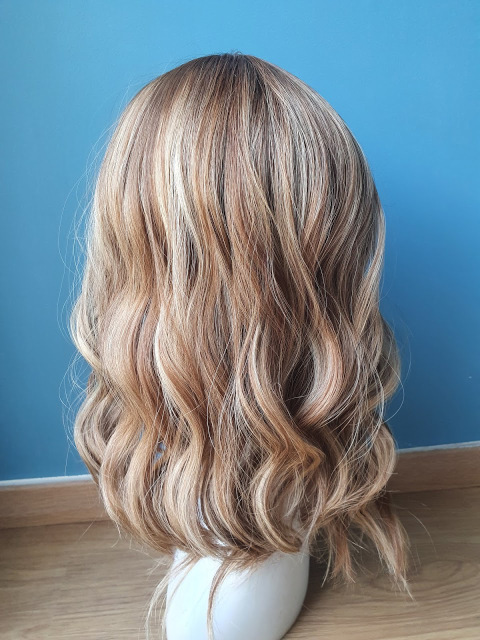
I am wearing the hairpiece Anaïs from Comme un diadème, with a length of 20 inches.
Hair supplement: When should you take the plunge?
Many women ask me what is the best time to switch to a hair supplement. I think they wonder at what level of alopecia it is justified to do so. My opinion is rather that one should try this solution before alopecia has too negative an impact on our lives. Indeed, the level of psychological suffering is not necessarily proportional to the extent of androgenetic alopecia. Some women with very moderate androgenetic alopecia may sometimes suffer much more than women who have almost no hair left. Therefore, the important thing is to assess whether we feel the need to overcome this complex to feel good and fulfilled.
The hair supplement or wig can really allow us to feel beautiful again. They help us regain our self-confidence. I myself spent several years feeling self-conscious because of my thinning scalp. I felt physically diminished while there was this solution that later changed my life. If I had to do it again, I think I would have done it much earlier to avoid losing several years feeling self-conscious. I would therefore advise not to wait until you are completely unhappy because of your alopecia to consider this solution.
Regarding the extent of alopecia, I would also advise not to wait until alopecia is too visible. A woman who still has moderate alopecia can switch to a hair supplement without the transition being noticed by those around her. However, if the alopecia is already really extensive, it may be more difficult to make the change unnoticed.
However, switching to a hair supplement or wig is not a simple step to take psychologically. It took me personally four years of reflection to really take this step. You have to be truly ready for it, as a hair prosthesis will never replace the hair you have lost.
A genuine psychological acceptance of this solution is often necessary for this step to go as smoothly as possible. A woman who is not completely ready to wear a hair topper may reject this solution permanently for the wrong reasons. Comme un diadème allows product returns after ordering.
Trying a hairpiece is already an important first step in the process. But if the hairpiece doesn't suit you, it's important to identify the real reasons. Indeed, a hair topper that doesn't fit because you don't feel ready might actually suit you very well a few years later 😉. There will always be time to return to this solution when you truly feel ready for it 😊
To discover the hair supplements and wigs currently in stock, click on:
Join the Comme un diadème community on our social networks!









This article really resonates with what some of my clients have experienced. I have seen how hair loss due to androgenetic alopecia can have a huge impact on self-confidence and self-esteem. Some clients have spent years trying to hide their thinning areas with different hairstyling techniques and products, but ultimately, they realized that these solutions were not sustainable.
For many of them, switching to a hair supplement was a difficult decision to make. Some took time to get used to it and had to do genuine psychological work to accept this new step. But once they took the plunge, they regained a confidence and joy of living that they hadn't felt in a long time.
That is why I agree with the author of this article on the importance of considering hair extensions before alopecia has too negative an impact on daily life. It is crucial to recognize that everyone has their own pace to accept this solution and that there is no specific level of alopecia that determines when to take the plunge. As a hairdresser, I am here to support my clients in this process and help them find the solution that suits them best.
Alex
This article is a breath of fresh air for all those struggling with androgenetic alopecia. Thank you for sharing concrete solutions and bringing hope with hair extensions, it is so reassuring to know that there are options to feel beautiful and confident again! 🌺✨